

Money—the lifeblood of civilizations and the unseen force that shapes our world. From the ancient temples of Mesopotamia, where the first loans were recorded in clay, to the opulent trading floors of Wall Street, the story of finance is the story of humanity’s ambition, creativity, and, sometimes, its folly.
In this article, we’ll cover how finance, a mere tool for trade and trust, became the architect of our modern world. This goes beyond crunching numbers or spinning economic theories. It’s about how this not-so-visible but ever-present force has been quietly shaping our world, guiding us from way back then to right now.
Early Barter Systems and the Transition to Commodity Money
In the earliest chapters of human civilization, finance was about barter—the direct exchange of goods and services. Your average farmer, for example, might trade a portion of his harvest for a potter’s wares or a builder’s skills. This system worked well in small, close-knit communities, but it had its limits. What if the potter didn’t need grain right then, or the farmer didn’t need a new pot?
This is when commodity “money” started to enter the picture. In other words, a system where goods like grain, cattle, and later precious metals became a universal medium for trade. Commodity money had intrinsic value and was widely accepted, making trade easier and more flexible.
This shift was crucial. People could trade more freely without needing a direct ‘want’ match. It also laid the groundwork for a more complex economy where value could be stored and accumulated beyond immediate goods.

Coinage and Its Role in Ancient Economies
The next big leap was the creation of coinage. Around 600 B.C., in Lydia (now modern-day Turkey), we see the first use of minted coins. Suddenly, trading was not just easier; it was more precise and trustable. Coins could be counted and standardized, a game-changer for trade and the economy.
This early period of finance set the stage for everything that followed. It was a time of innovation and adaptation, where the concepts of value, trade, and wealth began to take on forms that are still recognizable in today’s financial systems.
The Birth and Growth of Banking
The story of banking begins not in grand palaces or marketplaces but in the medieval streets of Italy, specifically in cities like Florence, Venice, and Genoa. These city-states, thriving in trade and commerce, became the cradle of modern banking in the 12th and 13th centuries. The early Italian bankers, or “banquiers,” started out by offering money-changing services to traders. They dealt with multiple currencies, necessitated by the diverse trade networks spanning Europe and beyond.
But they quickly evolved beyond simple currency exchange. These bankers began to offer loans, and with that, they became an integral part of the economic fabric. The concept of charging interest on loans, a practice once frowned upon and even forbidden in many cultures, became normalized. This was revolutionary, as it allowed for the growth of businesses and the stimulation of local economies.

The development of double-entry bookkeeping in the 14th century, also pioneered by the Italians, was one of the biggest milestones at the beginning of modern banking. This system enabled bankers to keep more accurate records of their debits and credits – a fundamental aspect of today’s financial accounting.
During the Renaissance, banking grew in sophistication and scale. The infamous Medici Bank, established by the Medici family in Florence, is a prime example. This bank extended its influence through branches across Europe, creating an early form of a banking network.
However, it wasn’t until the 17th century in England that we saw the emergence of banking in a form recognizable today. The founding of the Bank of England in 1694 as a private institution holding government funds and issuing banknotes marked a significant evolution. This model of a central bank, coupled with a network of commercial banks, laid the groundwork for the modern banking system.
Little by little, banks began to play a crucial role in national economies, financing ventures far and wide, from industrial innovations to colonial expeditions. The stability and growth of economies became increasingly tied to the health and function of banks, a trend that continues today.
Origins of Stock Markets in 17th-century Europe
The next important milestone in the evolution of finance was the emergence of the first stock market in Amsterdam, where the Dutch East India Company became the first to issue stocks and bonds to the general public. This was a groundbreaking development, as it allowed businesses to raise capital by selling shares to investors, a concept that spread rapidly across Europe.
Over the centuries, stock markets have grown to play a pivotal role in global finance. They’ve become barometers of economic health, influencers of wealth distribution, and drivers of economic policies.
As businesses from around the world list their shares, these markets have facilitated the rise of global corporations and have allowed investors from all walks of life to participate in the economic growth of these companies.
The Bond Market: Financing Empires and Wars
At the turn of the 14th and 15th centuries, the bond market started shaping financial history in profound and multifaceted ways. Its origins can be traced to Italy, where governments embroiled in constant warfare issued bonds as a primary means of raising funds. This era marked the beginning of what would become a high-risk, high-reward investment strategy, with investors betting on the success of governments in wartime.
Fast forward to the 19th century, and the Rothschild banking dynasty exemplified the strategic importance of the bond market. Their immense profits during the Napoleonic Wars and the American Civil War, achieved through tactics like misinformation and arbitrage, underscored how the bond market could be manipulated for substantial gain.
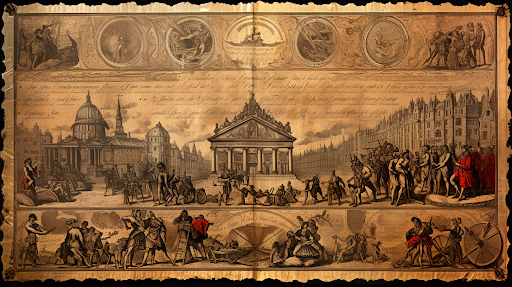
However, the bond market’s influence wasn’t confined just to wars and empires. It became a critical tool for governments to manage national debts and finance public infrastructure, fundamentally impacting economic growth and societal development. The ability to issue bonds allowed governments to undertake significant projects, driving national and global economic trends.
The bond market’s relationship with inflation, especially during periods of conflict, reveals its broader economic impact. Governments often borrow large sums to finance wars, leading to an expanded money supply and subsequent inflation. This phenomenon was starkly evident in instances of hyperinflation, such as in Germany post-WWI and Argentina in the 1970s.
The Role of Insurance In Managing Risk Through Centuries
Paralleling the bond market, the journey of insurance shows a remarkable evolution in risk management. Its first actual application began in 18th-century Scotland, where two ministers created the first modern insurance system, not just as a charitable endeavor but as a smart way to pool resources and provide for those in need. This was the beginning of using statistics and probability in finance.
What started in the taverns and churches of Scotland soon spread like wildfire. By the 19th century, insurance had become a staple of financial life. It was no longer a niche product for clergymen but a widespread tool for mitigating risks in trade and personal life. From ships braving the treacherous seas to merchants seeking to protect their goods, insurance became the safety net that allowed commerce and exploration to flourish.
But it wasn’t all smooth sailing (pun intended). Insurance highlighted social inequalities – not everyone could afford it. This gap led to the birth of the welfare state, aiming to provide broader coverage through policies like health care and pensions. A noble idea, but not without its critics, who argue it might make people a bit too financially comfortable.
Global Financial Systems and Crises
As the 20th century rolled around, the interconnectedness of financial systems became more evident. At this point in time, global finance is a set of dominoes. When one falls (say, a major bank in New York), the ripple effect can be felt worldwide, from Tokyo to London. This interconnectedness means that financial crises are no longer confined to national borders.
The Wall Street Crash of 1929 and the 2008 Financial Crisis were stark reminders of this interconnectedness. The Crash of 1929 led to the Great Depression, affecting economies worldwide. Similarly, the 2008 crisis, triggered by the collapse of the U.S. housing market, spiraled into a global financial meltdown. These events were wake-up calls, leading to a global reevaluation and restructuring of financial systems and practices.

The aftermath of WWII brought countries together at the Bretton Woods Conference, establishing the International Monetary Fund (IMF) and the World Bank. This was a pivotal moment in global finance, creating institutions aimed at preventing future economic disasters and promoting international cooperation. It was a recognition that in the world of finance, no country is an island, and collaborative approaches are essential.
As the century progressed, the financial world embraced deregulation, leading to freer markets and the rise of complex instruments like derivatives. This era of financial innovation spurred growth but also introduced new risks, highlighting the delicate balance in global finance.
The Digital Revolution in Finance
The leap from traditional banking to online banking and fintech represents the latest and one of the most exciting chapters in the evolution of finance. Just as the introduction of coinage or the establishment of central banks marked significant shifts, the advent of fintech and online banking is equally momentous.
The genesis of the digital revolution in finance can be traced back to the late 20th century. The introduction of the Internet paved the way for online banking, a concept that initially emerged as a convenience but soon evolved into a necessity. This period witnessed the birth and rapid growth of fintech companies. Leveraging technology, these companies began offering innovative financial services, challenging traditional banking models. The shift towards digital platforms made financial transactions more accessible, efficient, and secure.
But an even bigger change was brewing on the horizon. 2008 was a landmark year in the digital finance era, marked by the introduction of Bitcoin by Satoshi Nakamoto. Bitcoin, the first cryptocurrency, introduced the concept of a decentralized digital currency.
The underlying technology of cryptocurrencies, blockchain, emerged as a revolutionary tool for secure and transparent transaction recording. Its potential extended beyond cryptocurrencies, with promising applications in various sectors, including finance, supply chain, and governance.

Impact and Integration into the Financial Ecosystem
The proliferation of cryptocurrencies and blockchain technology has sparked debates and discussions in financial circles. While cryptocurrencies faced scrutiny and regulatory challenges, blockchain technology gained recognition for its potential to transform traditional financial operations.
Despite initial skepticism, traditional financial institutions began exploring and integrating digital innovations. The adoption of fintech solutions, blockchain technology, and even explorations into central bank digital currencies (CBDCs) signified a blending of traditional and digital finance.
The digital revolution in finance continues to evolve, characterized by rapid technological advancements and an ever-changing regulatory landscape. The rise of digital wallets, mobile banking apps, and online investment platforms is a testament to the ongoing transformation of the financial sector.
The Future of Money and Finance
The future of money and finance, while holding some uncertainty, is poised for continued evolution. The financial ecosystem of the future will be even more interconnected, with global events having amplified impacts across nations. This will necessitate stronger international cooperation and regulation to manage global financial health.
Money will continue to be a critical tool in global politics, with financial policies and controls being used to influence international relations and domestic agendas. Nations will need to balance the benefits of global financial integration with the need to maintain financial sovereignty and protect against cyber threats.
The future will likely see a continued rise in digital currencies, including the potential mainstream adoption of cryptocurrencies and the development of central bank digital currencies (CBDCs). These digital forms of money promise increased efficiency, security, and global reach.
Technologies like blockchain will enable more than just secure transactions. They’ll pave the way for smart contracts and decentralized finance (DeFi), automating and democratizing financial services, potentially reducing reliance on traditional financial intermediaries.